

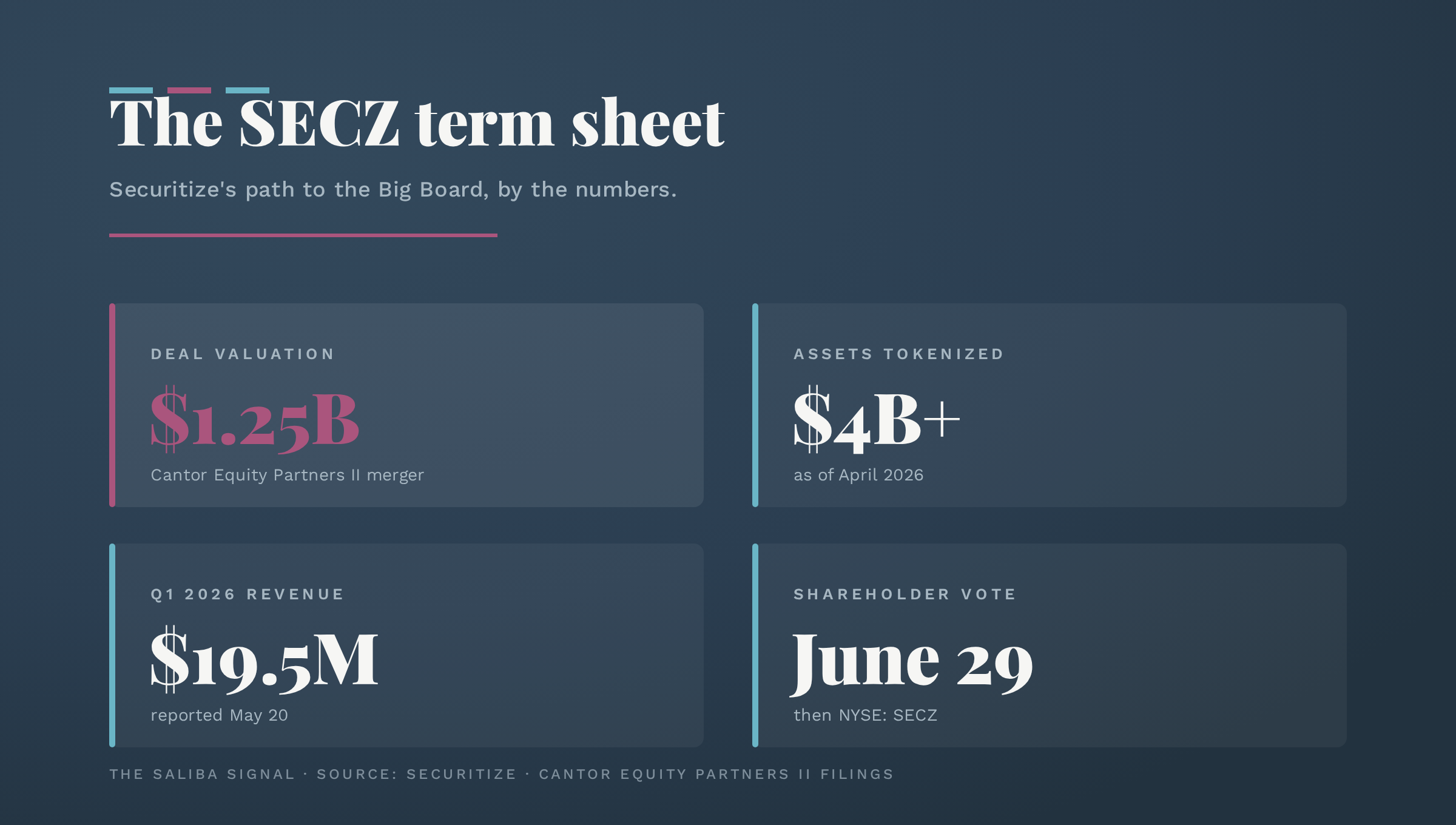
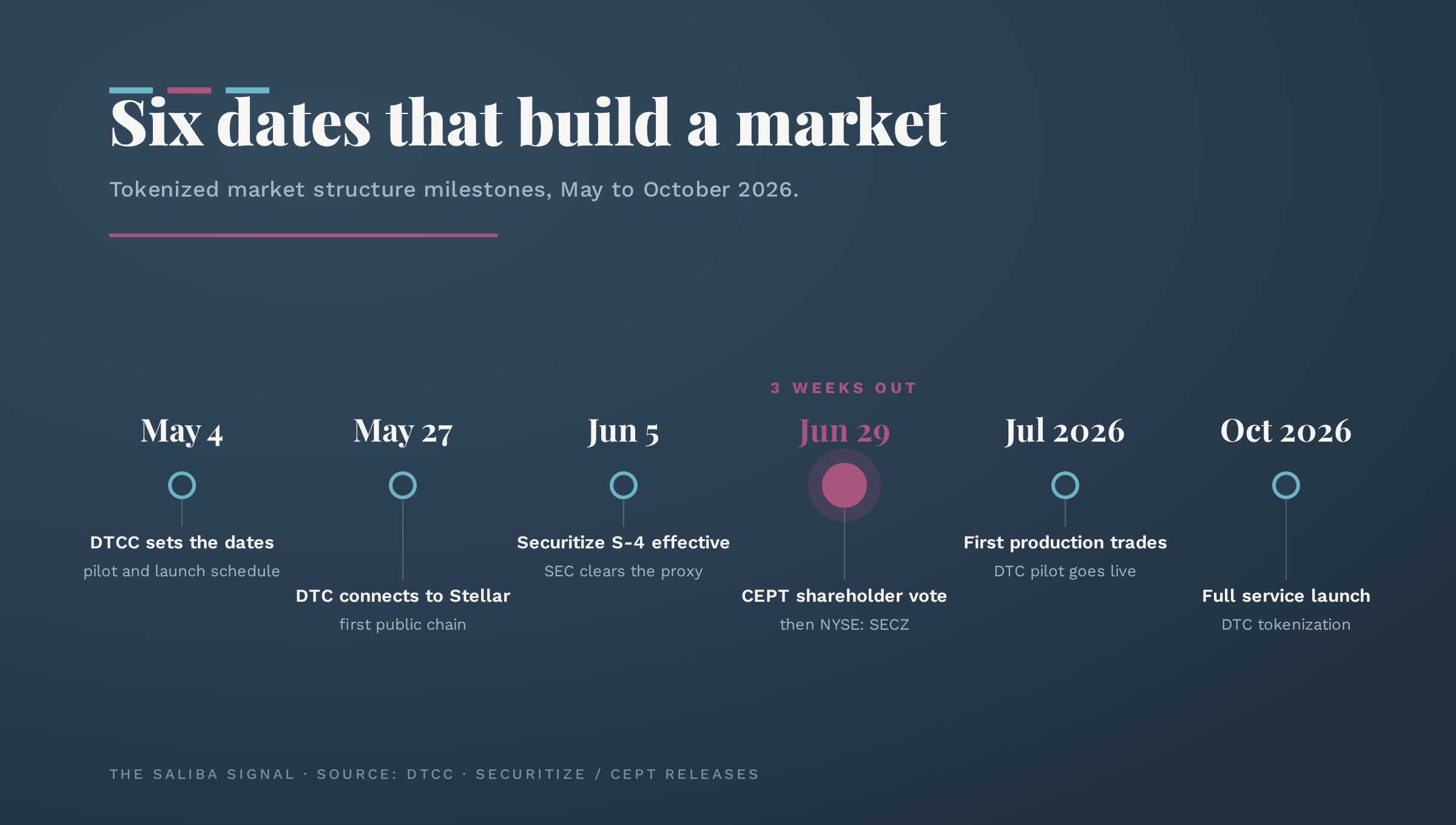
On June 5 the SEC declared Securitize's registration statement effective. The shareholder vote is set for June 29. If it passes, the company that runs BlackRock's tokenized funds will be trading on the New York Stock Exchange under the ticker SECZ within days of the count.
For the past month I've been writing about incumbents moving into tokenization. TP ICAP stood up the trading layer in April. DTCC put dates on settlement in May. Bullish bought the records layer. This week the story flipped. A firm that has been doing this work since 2017 is about to become a stock you can buy.
The Deal on the Table
The merger was announced October 28, 2025. Cantor Equity Partners II, a SPAC sponsored by an affiliate of Cantor Fitzgerald, is combining with Securitize at a $1.25 billion valuation, with a $225 million PIPE led by ParaFi Capital, Borderless Capital, and Hanwha Investment & Securities on top of $244 million held in the SPAC trust. The existing owners are not heading for the exit. BlackRock, ARK Invest, Hamilton Lane, Morgan Stanley Investment Management, and Tradeweb are rolling 100% of their stakes into the public company.
The asset behind the ticker is a set of regulated operating businesses. Securitize runs an SEC-registered broker-dealer with an alternative trading system, an SEC-registered transfer agent, a fund administration business, and the only regulated digital-securities license stack that spans both the U.S. and Europe. It has tokenized more than $4 billion in assets as of April, including BUIDL, the BlackRock treasury fund that became the reference product for the entire category. First quarter revenue came in at $19.5 million.
The First Public Mark
For three years the value of the tokenization business has been a private argument. Venture rounds, strategic stakes, the occasional acquisition where the price said more about the buyer than the asset. Bullish handing over $4.2 billion for Equiniti in May was the loudest data point so far, and even that one priced a transfer agent with a century of other business attached. SECZ is different. From the first print, every bank with a tokenization working group gets a public comp that trades daily.
The comp starts out rich. A $1.25 billion valuation against $19.5 million in quarterly revenue works out to roughly sixteen times annualized sales. Nobody pays sixteen times sales for a transfer agent. That price is a bet on how much of the market eventually settles on chain, which makes SECZ more useful than another funding headline. It is a live, daily market opinion on everything I've been covering since May 8.
One callback worth collecting. After Bullish bought Equiniti, I wrote that the thing to watch was whether anyone else moved on the transfer-agent business, and I named Computershare. Securitize had already answered. On April 29 the two firms signed an agreement to enable issuer-sponsored tokenized shares for U.S. companies. The transfer-agent layer keeps turning out to be where the real positioning happens.
Listed the Old Way
Here's the part I enjoy. The company whose product is atomic settlement is going public through the oldest machinery on the Street: an S-4 reviewed by the SEC, a proxy mailed to shareholders of record as of May 11, a special meeting, a vote. When SECZ starts trading, the shares will settle T+1 through DTC, a full day slower than the funds the company administers. Carlos Domingo, the co-founder and CEO, has said Securitize plans to tokenize its own shares once public. Until that day, the tokenization business clears the same way everything else does.
I watched a version of this from the inside. In 2010 the CBOE, my home floor since 1978, demutualized and took a ticker of its own. The institution didn't change overnight. The scoreboard did. Once the institution carries a daily closing price, every decision gets graded in public, quarter after quarter. That discipline arrives for tokenization the day SECZ opens.
Between Now and the Vote
The redemption number on June 29. The trust holds $244 million, but SPAC shareholders can take their cash back instead of riding into the deal. The redemption rate is the cleanest read available on what public investors actually believe about tokenization at this price.
Whether SECZ itself goes on chain. A listed company keeping its own share register on chain would be a first for a U.S. exchange. If it happens, it means the NYSE and the SEC are further along on tokenized equity mechanics than either has said out loud.
The collision with the July pilot. DTC's first production tokenized trades are scheduled for weeks after this deal is set to close. A freshly listed tokenization stock trading through the first institutional prints gives the market something it has never had, a price that reacts to pilot progress in real time.
Bottom Line
Since early May the tokenization story has been incumbents writing checks and regulators drafting frameworks. A Big Board ticker changes the audience. After June 29, the story I've been tracking week by week becomes something anyone can own or bet against at the close.
This business got built in private and it gets priced in public. The pricing is where the truth comes out. Three weeks to the vote.
All the best,

— Tony