

For a month I've been writing about tokenization getting built one layer at a time. This week it got a date.
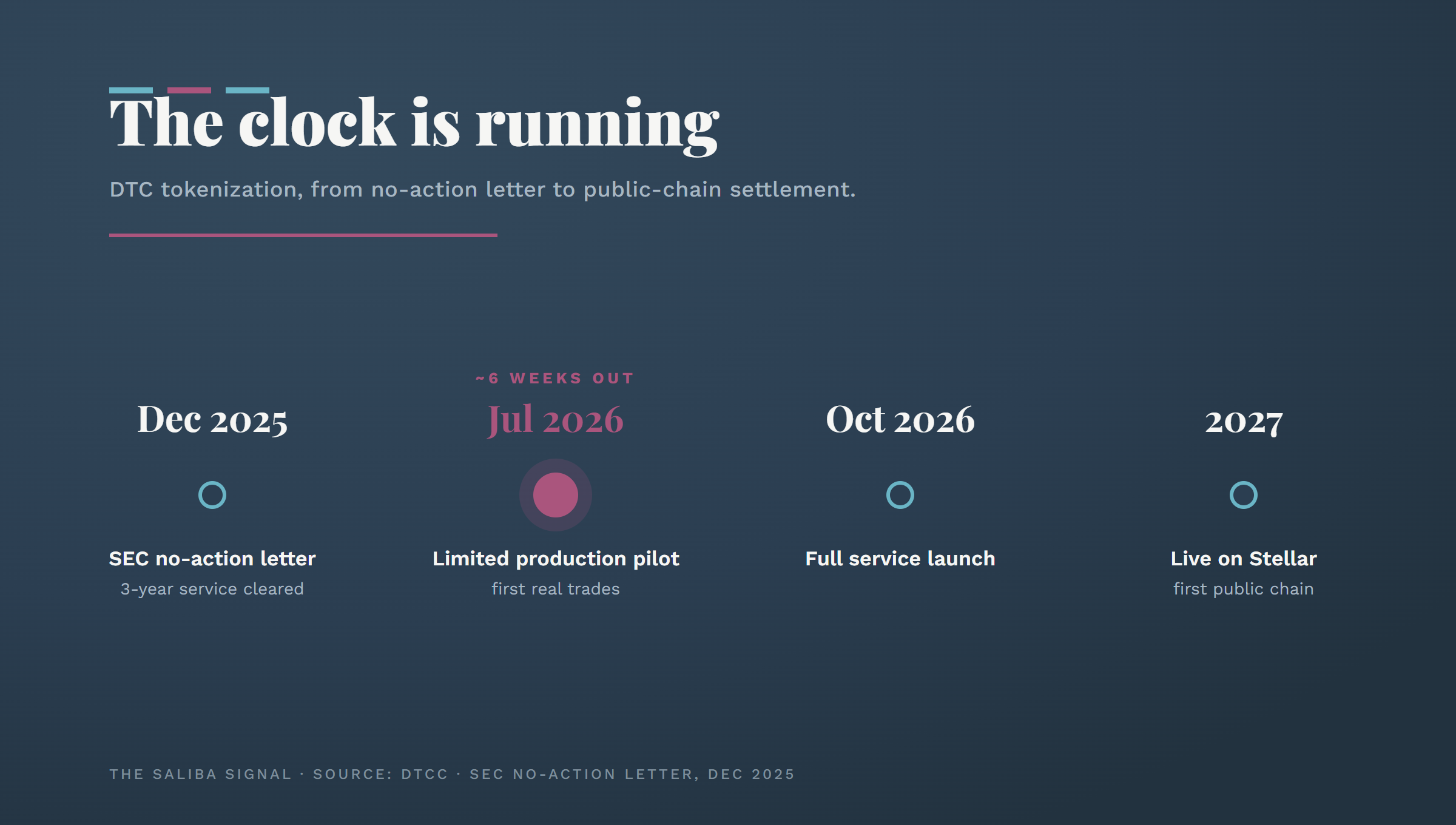
On May 27, DTC announced it would connect its tokenization service to Stellar, making it the first public blockchain to receive DTC-custodied assets. The first production trades are scheduled for July. The full service launch is October. The pilot is about six weeks out.
The Pilot Is Real
Here is what DTCC confirmed on May 4, and what the Stellar announcement extended on May 27.
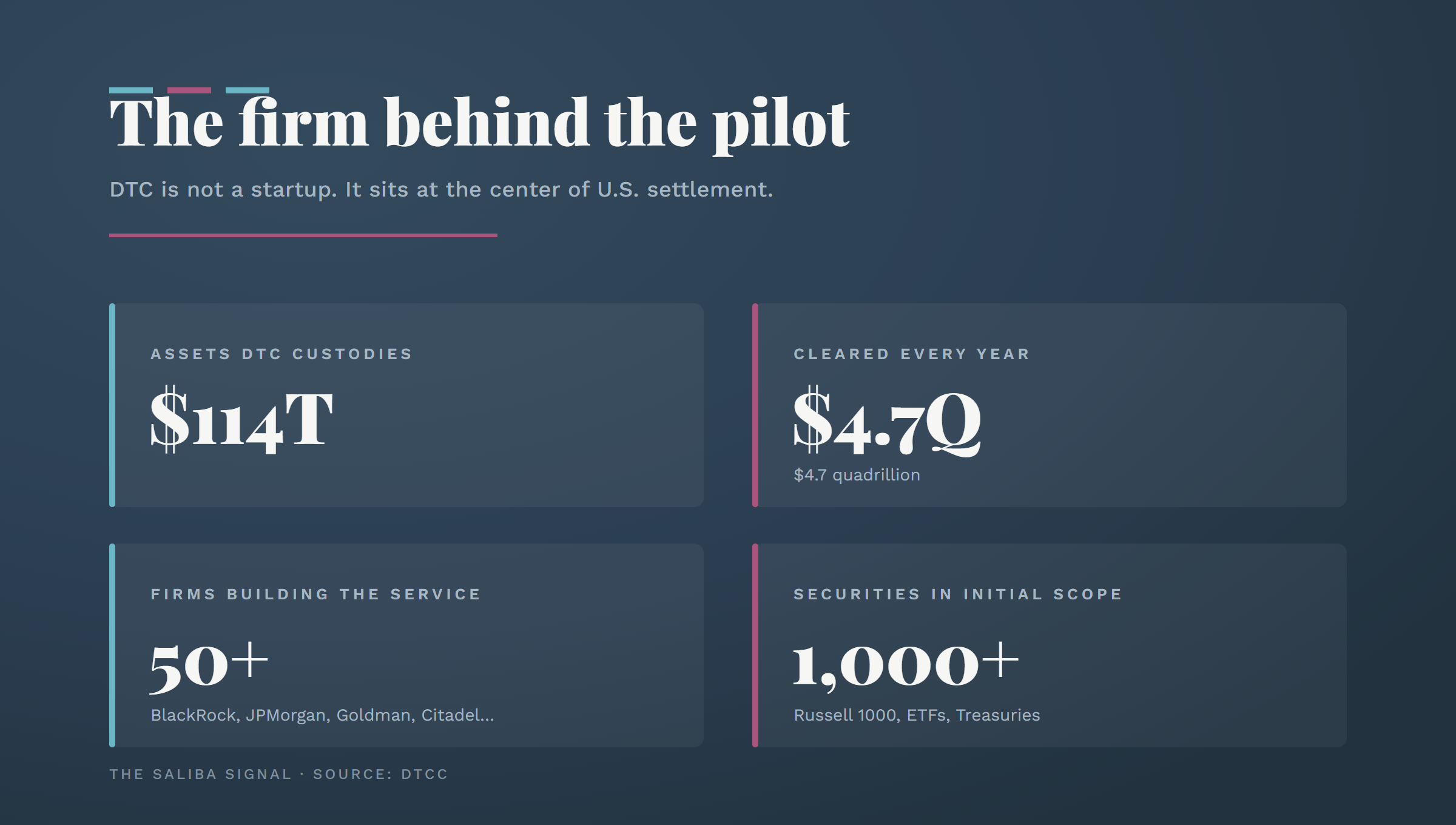
DTC custodies over $114 trillion in assets. In December 2025, it received a no-action letter from the SEC authorizing a three-year tokenization service covering the Russell 1000, major ETFs, and U.S. Treasuries. More than 50 firms have been working inside the DTCC Industry Working Group to shape the service: BlackRock, Goldman Sachs, JPMorgan, Citadel Securities, Morgan Stanley, Charles Schwab, Robinhood, Circle, and Ondo Finance, among others. That list is not a press conference photo op. Those firms are building.
July is the limited production pilot, with real assets, real participants, and operational proof. October is the service launch.
The Stellar announcement is the part that changes the story from "institutional tokenization" to "institutional tokenization on a public chain." Until May 27, the assumption was that DTC-tokenized assets would stay on permissioned ledgers, moving between known participants in a closed network. The plan now is different. DTC-custodied securities will live on Stellar in 2027. DTCC called it the first step in a multi-chain strategy.
Sit with that for a second. The entity that settles the overwhelming majority of U.S. equity trades just said it plans to put those assets on a public blockchain in production, not a test environment or a sandbox.
Who This Squeezes
I've watched markets compress one settlement cycle at a time for forty-nine years. T+5 to T+3 to T+2 to T+1. Each compression cut the float the slow firms were quietly earning interest on. Capital that used to sit in transit for days started working in hours. The firms that had built their operating model around the old cycle had to either rebuild from the floor up or hand over the spread.
This is the same mechanics. Harder math.
When DTC tokenizes an asset, settlement becomes atomic. The two-day window that currently sits between trade execution and finality disappears. For most retail investors, that sounds like a feature. For the firms that have always operated in that two-day window (financing, securities lending, float management), it's a revenue line that gets compressed away.
JPMorgan filed to launch a second tokenized money market fund on Ethereum on May 13. They seeded it with $100 million of their own capital. BlackRock has had $1.8 billion in its tokenized BUIDL fund since 2024. These firms are not waiting for the SEC framework to tell them what to do. They're building the assets that will move through the service DTC is standing up.
The interesting question here is who controls the settlement layer once the assets start moving.
What I'm Watching
The July pilot participants and what they actually settle. The first production trades will tell you more than a year of press releases. Watch which firms go first and which asset classes they start with. That order of operations is not random.
Whether the SEC's tokenized-stock framework resurfaces before October. The agency pulled the innovation exemption in late May after Nasdaq, NYSE, and Cboe raised market-structure concerns. The exchanges that pushed back are also in DTCC's working group. That is not a contradiction. It's positioning. They want to control the pace of what goes live on which venue.
What OCC says about listed options on tokenized underlyings. I raised this two weeks ago and it hasn't gotten quieter. DTC-tokenized Russell 1000 stocks are going to trade alongside listed options that settle at OCC against the traditional underlying. Once the pilot goes live in July, someone has to start answering that question in writing.
Whether Stellar is the last public chain in DTCC's strategy or the first. DTCC called it a multi-chain approach. Ethereum, Solana, and Base already hold the largest share of tokenized asset value outside permissioned networks. DTC connecting to one public chain makes it easier, not harder, to connect to the next.
Bottom Line
What I've been writing about since May 8 goes live in six weeks, as a production service run by the firm that clears $4.7 quadrillion a year, with more than 50 of the biggest names in finance already working inside the system.
I've watched every compression cycle restructure this market. The asset class that gets tokenized first matters less than which firms own the infrastructure that moves it. In six weeks, we'll start to see which ones built and which ones are still catching up.
All the best,

— Tony