
Crypto prime brokerage risk management is the set of limits, data and controls a prime broker or institutional desk uses to avoid losing money when a counterparty, custodian, exchange or bank fails, or when prices move hard. Every layer has failed at least once since 2022, so the checks need to run daily and, for limits, before each trade.
What is crypto prime brokerage risk management?
A prime broker offers hedge funds and other institutions a bundle of services: financing, execution, custody and clearing. The BIS describes prime brokerage as a set of services that broker-dealers offer to hedge funds and other non-bank institutions, centred on leverage (BIS Quarterly Review, March 2024). For the full picture, see crypto prime brokerage and the prime broker glossary entry.
In crypto, the prime broker also has to manage risks that traditional markets keep inside regulated clearing houses: assets prefunded on exchanges, private keys, bilateral settlement with dealers and markets that never close. Risk management covers how that exposure is measured, limited and reported.
Five places crypto exposure fails
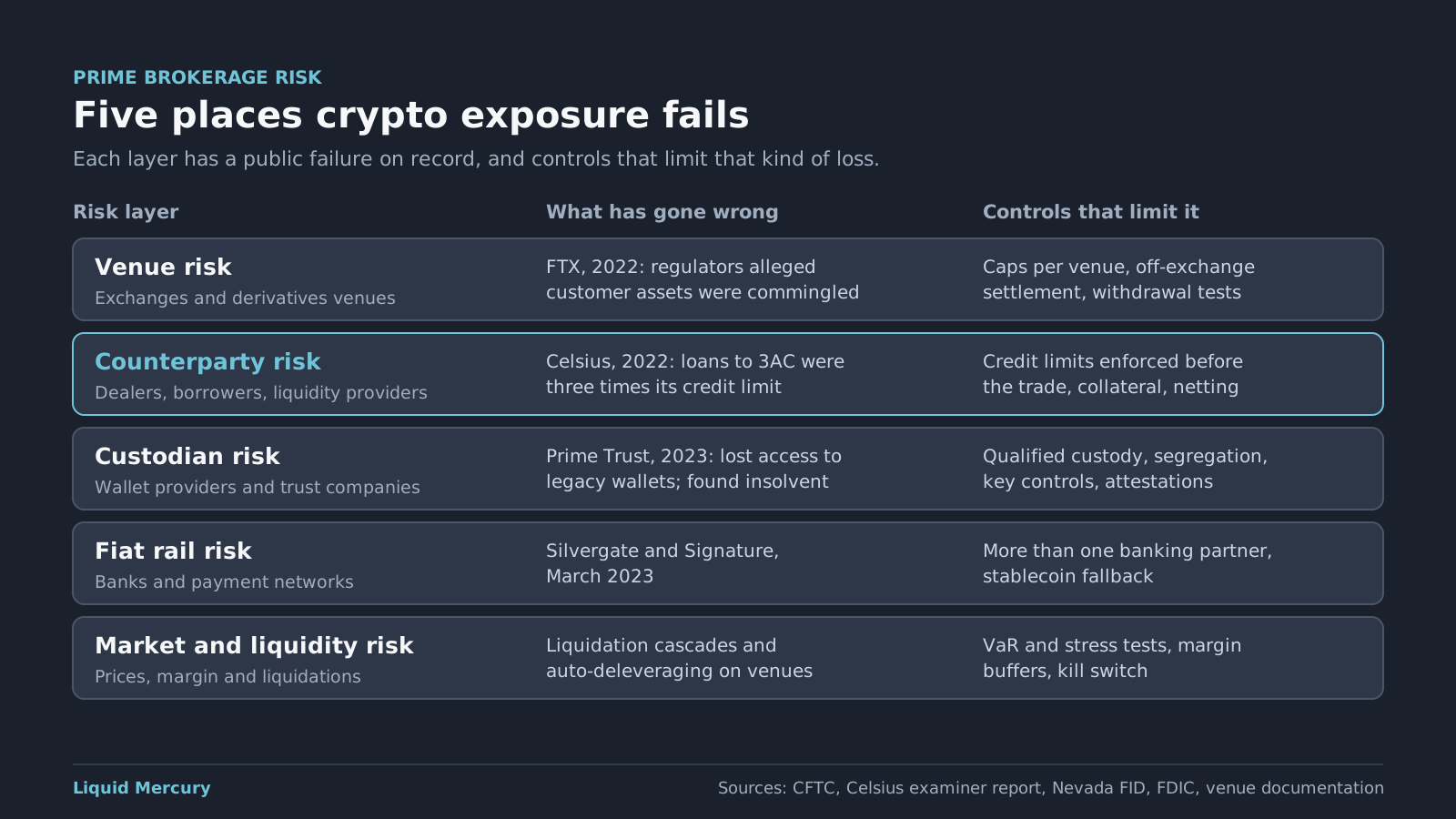
- Venue risk. The CFTC alleged that FTX customer assets were routinely held by Alameda Research and commingled with its funds, while FTX told customers their assets were segregated (CFTC, December 2022). Assets on an exchange are only as safe as that exchange.
- Counterparty risk. The court-appointed examiner in the Celsius bankruptcy found that Celsius's loans to Three Arrows Capital were three times its credit limit, and that Celsius staff could not explain why the limits were not enforced (Celsius examiner report).
- Custodian risk. Nevada's Financial Institutions Division petitioned for receivership of Prime Trust in June 2023, finding it insolvent (Nevada Department of Business and Industry). The petition says Prime Trust could not access a set of legacy wallets and used customer money to buy replacement crypto (petition).
- Fiat rail risk. In March 2023 Silvergate announced a voluntary wind-down and Signature Bank was closed by its regulator (FDIC). Both had served as dollar rails for crypto firms.
- Market and liquidity risk. Derivatives venues close out losing positions, draw on an insurance fund and, as a last step, can reduce profitable traders' positions through auto-deleveraging (Binance Futures).
For bilateral OTC exposure specifically, see counterparty risk in digital asset OTC trading.
What to monitor every day
| Exposure | What to measure | Typical data source |
|---|---|---|
| Venues | Balance and open positions on each exchange, against a cap | Venue APIs, internal books |
| Counterparties | Credit used against each limit, collateral held, unsettled trades | Risk engine, settlement system |
| Custodians | Assets held, segregation, latest attestation or audit | Custodian reports, attestations |
| Exchange health | Withdrawal delays, wallet outflows, reserve disclosures | On-chain analytics, venue disclosures |
| Market | Value at risk, stress losses, margin headroom, liquidity depth | Market data, margin systems |
| Banking rails | Cash at each bank and payment partner | Treasury systems |
On-chain analytics firms label wallet addresses by owner, which lets a desk watch flows in and out of an exchange's known wallets. Large or unusual outflows, slower withdrawals and changes in disclosed reserves are early signals worth an alert.
What proof of reserves does and does not show
Proof of reserves compares customer balances with assets the exchange shows it controls, usually with a Merkle tree so each customer can check their own balance is included. Kraken, for example, describes an independent accountant confirming that assets exceed or match client balances (Kraken).
It is a snapshot, not an audit. It may not show the exchange's other liabilities, whether the assets were borrowed for the test, or what moved the next day. Use it as one input next to audited financial statements, regulatory status and live monitoring.
Pre-trade controls that matter
- Counterparty credit limits. Block a trade or loan that would take a counterparty over its limit. The Celsius case shows why the check has to be automatic.
- Venue caps. Stop routing to a venue once its balance or exposure cap is reached, and when it pauses withdrawals.
- Order limits. Maximum size, notional and price collars to catch errors.
- Restricted assets and regions. Block assets or pairs that a client or region cannot trade.
- Margin checks. Confirm collateral covers the new position before it opens.
- Kill switch. Let risk staff halt all trading for a client, strategy or venue at once. See kill switch.
These checks belong in the order path, inside the execution system, so every route is covered. See crypto execution management system.
VaR and stress testing for crypto portfolios
Crypto prices move more, and around the clock, so risk numbers need to update intraday and stress scenarios need to include crypto-specific events: an exchange halting withdrawals, a stablecoin losing its peg and a sharp fall in a major coin over a weekend. Back-test the model against real crypto drawdowns, not only the calm periods in recent data.
The Basel Committee's cryptoasset standard, with a target implementation date of January 1, 2026, sorts bank exposures into groups. Basel standards acquire legal effect through local implementation; the binding requirements and commencement dates depend on the bank's jurisdiction and supervisor (BCBS charter). Exposure to Group 2 assets, which include unbacked cryptoassets such as bitcoin, should generally not exceed 1% of Tier 1 capital and must not exceed 2% (Basel Framework, SCO60). The Committee agreed in November 2025 to expedite a review of parts of the standard (BIS).
Reducing venue exposure with off-exchange settlement
Off-exchange settlement lets a trader keep assets with a custodian while the exchange extends trading credit against them. Gains and losses settle between custodian and exchange on a schedule, so less sits on the venue at any time. BitGo, for example, describes its Go Network as settlement without assets leaving its qualified custody (BitGo). Check how often settlement happens, what happens if either side fails mid-cycle, and which venues are connected.
Custody vs prime brokerage
| Custodian | Prime broker | |
|---|---|---|
| Main job | Safekeeping of assets and keys | Financing, execution, custody and reporting in one relationship |
| Lends to clients | Usually no | Yes, against collateral |
| May use client assets | Depends on the legal terms; check asset segregation and any authority to reuse assets | Only as the agreement allows, for example as collateral |
| Main risk to client | Custodian failure or key loss | Prime broker failure, rehypothecation, margin calls |
For investment advisers registered or required to register with the SEC, the custody rule generally requires a qualified custodian for client funds and securities in the adviser's custody, subject to the rule's exceptions. It is not a blanket custody rule for every digital asset or every adviser. Check the asset classification, custody arrangement and applicable exceptions with counsel (17 CFR 275.206(4)-2). For custody options, see crypto custody solutions.
Core software modules of a digital asset prime brokerage platform
- Client onboarding with KYC and AML
- Order and execution management across venues and dealers
- A risk engine with pre-trade and post-trade checks
- Margin, financing and collateral management
- Custody integrations and wallet management
- Settlement and reconciliation
- Client and regulatory reporting
For a broader view of services, see digital asset prime services.
Where Mercury Pro fits
Liquid Mercury, the Chicago-based institutional digital asset infrastructure provider, built risk checks into the order path of Mercury Pro. Its product page lists pre-trade and post-trade risk controls, real-time position monitoring, automated margin alerts and configurable exposure limits across all venues and strategies, with risk dashboards and full audit trails. Mercury Pro connects to the custodians, OTC liquidity providers and exchanges listed on its page, so exposure can be watched from one system.
Frequently Asked Questions
What risk management tools do crypto prime brokers offer clients?
How can a desk monitor exchange solvency?
What is the difference between crypto custody and prime brokerage?
What is the difference between crypto prime brokerage and trading on an exchange?
Does proof of reserves prove an exchange is solvent?
How do prime brokers set credit limits for crypto counterparties?
Mercury Pro
Mercury Pro puts pre-trade risk checks, exposure limits and margin alerts inside the order path, across every connected venue.
Request a Mercury Pro demoRelated Reading
Counterparty Risk in Digital Asset OTC Trading
How bilateral OTC trades create counterparty exposure and how desks limit it.
Crypto Custody Solutions
How institutional crypto custody works and what to compare between providers.
Digital Asset Prime Services
The services a digital asset prime broker provides and how they fit together.
Crypto Liquidity Sourcing
Where institutional desks find crypto liquidity and how to route between sources.