
An execution management system (EMS) is the software a trader uses to work an order after it has been approved: picking venues, slicing the order with algorithms, checking risk, watching fills and measuring the result. A crypto EMS does that job across exchanges, OTC liquidity providers and derivatives venues that never close.
What is an execution management system?
An execution management system is a trading application built around one question: now that we have decided to buy or sell, how do we get the best result? It gives the trader live market data from several venues, tools to place and work orders, and a record of every fill. See the execution management system glossary entry for the short definition.
The EMS is usually the last piece of software an order touches before it reaches a venue. It chooses where to send each child order, applies execution algorithms such as TWAP or VWAP, and runs pre-trade checks so an order that breaks a limit never leaves the building.
Execution quality is a regulatory expectation as well as a commercial one. In US equities, FINRA Rule 5310 requires brokers to use reasonable diligence to find the best market for a customer order, and that idea carries over to how institutions judge crypto execution. See best execution.
EMS vs OMS vs PMS
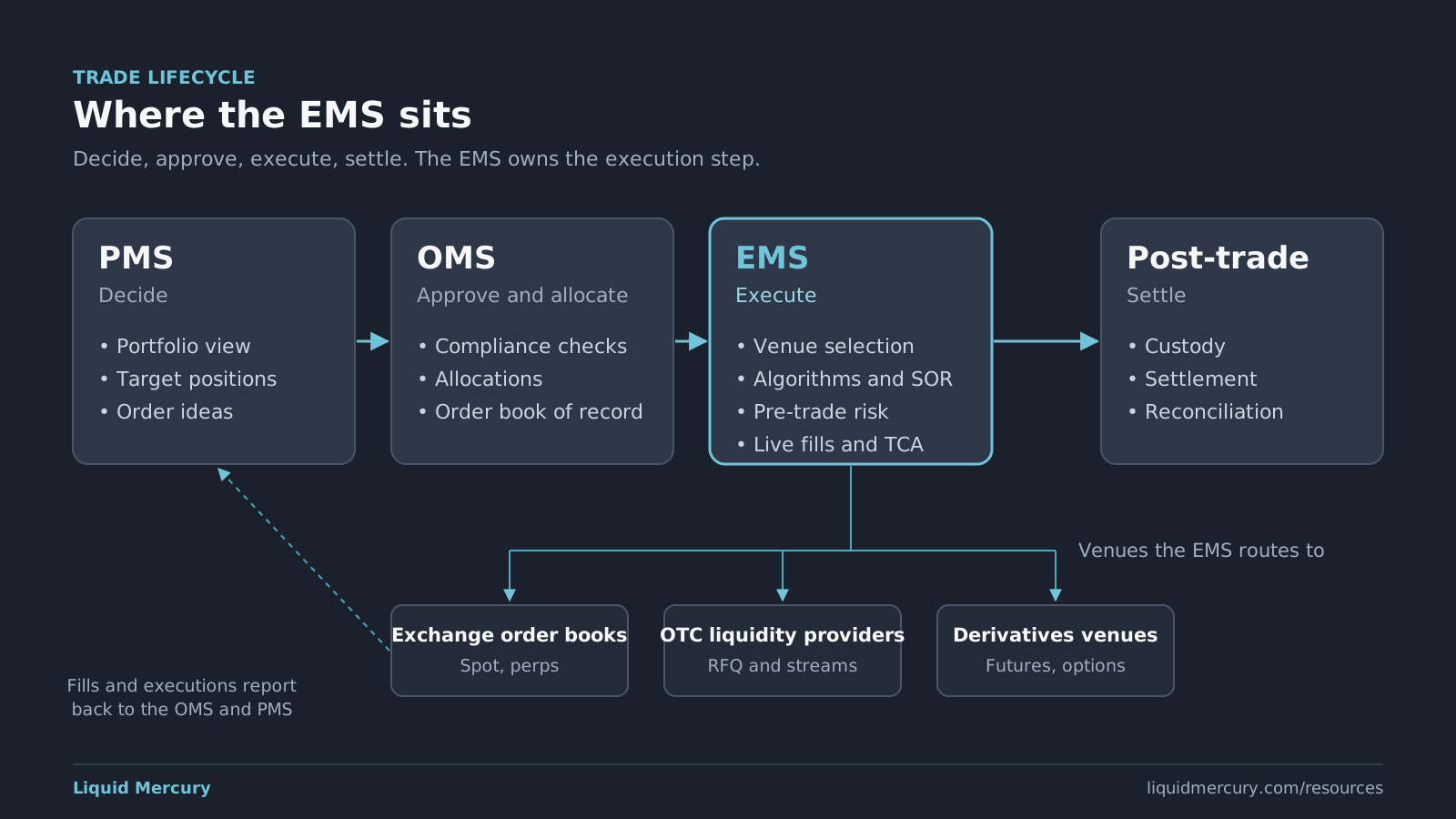
Three systems share the trade lifecycle, and the names get blurred in sales material. The split below is the common one.
| System | Main user | Job | What it produces |
|---|---|---|---|
| Portfolio management system (PMS) | Portfolio manager | Decide what the portfolio should hold | Target positions and order ideas |
| Order management system (OMS) | Trading desk, compliance, operations | Record, approve and allocate orders | The order book of record and allocations |
| Execution management system (EMS) | Trader | Work the order in the market | Fills, execution prices and analysis |
Many institutional desks now buy an order and execution management system (OEMS) in one product, because two systems mean two copies of every order. The glossary covers the order management system and the portfolio management system in more detail.
What a crypto EMS has to handle that an equity EMS does not
- No closing bell. Crypto markets trade every hour of every day. Algorithms, risk limits and alerts have to keep working overnight and through weekends, and someone has to be able to stop them. See kill switch.
- Many venue APIs. Each exchange has its own symbols, order types, rate limits, fee schedules and error codes. The EMS has to normalize all of them so the trader sees one book.
- Prefunded venues. Most crypto exchanges need assets on deposit before an order can fill, so the EMS has to know the balance on each venue, not just the firm's total position. See pre-funding.
- OTC next to the order book. A large order may be better priced by a request for quote to liquidity providers than by sweeping public books. A useful crypto EMS shows both. See RFQ and request for stream.
- Spot and derivatives together. Desks often hedge spot with perpetual swaps, futures or options on other venues, so multi-leg orders matter.
- Venue risk. An exchange can halt withdrawals or fail. The EMS should make it easy to see and cap how much sits on each venue.
Core features of a crypto EMS
| Feature | What it does | What to check |
|---|---|---|
| Direct market access | Sends orders straight to each venue through your own accounts | Which venues, which order types, and how API keys are stored |
| Smart order routing | Splits and routes an order across venues for the best available price | Does it route on fees, depth and latency, or price alone? |
| Execution algorithms | TWAP, VWAP, sweep, chase, iceberg and similar strategies | Can you set parameters per order, and can the vendor add new ones? |
| RFQ and streaming | Requests quotes from OTC liquidity providers inside the same screen | Which providers, and are quotes firm or indicative? |
| Pre-trade risk | Blocks orders that break position, notional, price or venue limits | Are checks enforced before the order is sent, on every route? |
| Analytics | Shows slippage against arrival price and other benchmarks | Can you export fills for your own transaction cost analysis? |
| Connectivity | FIX, REST and WebSocket APIs for your own systems | FIX version support and how drop copies reach your OMS |
For the routing logic itself, see smart order routing in crypto. For the algorithms, see crypto execution algorithms. For measuring the result, see transaction cost analysis.
How to choose an EMS provider
EMS providers fall into four broad groups. Multi-asset EMS vendors from traditional markets that have added crypto venues. Crypto-native order and execution platforms built for digital asset desks. Front ends supplied by an exchange or broker, which usually route only to that firm. And in-house builds. Each can be the right answer. The questions below separate them quickly.
- Venue coverage. List the exchanges, OTC liquidity providers and custodians you use today and the ones you expect to add in a year. Ask for live connections, not a roadmap.
- Asset coverage. Spot only, or spot, perpetuals, futures and options? Tokenized securities and stablecoins?
- Risk controls. Which limits are checked pre-trade, and can compliance change them without a code release?
- Integration. How does the EMS talk to your OMS, risk system and books and records? Ask for a FIX specification. See FIX API connectivity for crypto.
- Deployment. Hosted, private cloud, co-located or white-labelled for your own clients?
- Resilience. What happens when a venue API fails mid-order? How are partial fills and cancels reconciled?
- Support and coverage hours. Crypto never closes, so ask who answers the phone on a weekend.
- Data ownership. Can you take your order and fill history with you if you leave?
- Commercial model. Seat license, volume-based fees or platform license, and what is charged for each new venue?
If you are weighing an in-house build against a vendor, read build vs buy for a crypto OTC platform. To compare platforms side by side, see institutional crypto trading platforms compared.
Where Mercury Pro fits
Liquid Mercury, the Chicago-based institutional digital asset infrastructure provider, built Mercury Pro as an EMS and OMS for institutional desks trading digital assets. Its product page lists direct market access, smart order routing, real-time risk and pre-trade controls, and an algorithmic suite that includes Sweep, TWAP, Chase and Spreader, plus market making, volatility trading, OTC posting and risk management strategies.
Mercury Pro connects to exchanges, OTC liquidity providers and custodians listed on its page, across spot, perpetuals, futures and options, with FIX, REST and WebSocket APIs. Ask Liquid Mercury for the current venue list and for a walkthrough against the questions above.
Frequently Asked Questions
What does EMS mean in trading?
Who uses an execution management system?
What does an EMS platform include?
Can an EMS route to both RFQ and order book liquidity?
Can an EMS use exchange risk signals in pre-trade checks?
How do EMS providers charge?
Mercury Pro
Mercury Pro gives institutional desks one EMS and OMS for digital assets, with multi-venue routing, execution algorithms and pre-trade risk controls.
Request a Mercury Pro demoRelated Reading
Institutional Crypto Trading Platforms Compared
How institutional crypto trading platforms differ on execution, connectivity, risk and deployment.
Smart Order Routing in Crypto
How a smart order router splits a crypto order across venues and what it weighs beyond price.
Crypto Liquidity Sourcing
Where institutional desks find crypto liquidity, how they reach it by API, screen and voice, and how to measure it.
Crypto Prime Brokerage Risk Management
How desks monitor counterparty, custodian and venue risk, and the controls that limit exposure.