
Crypto liquidity sourcing is the work of finding enough size, at a fair price, across exchanges, OTC desks, liquidity providers and on-chain pools, then reaching it without moving the market against you. For an institutional desk it is a routing and relationship problem as much as a technology one.
What is crypto liquidity sourcing?
Liquidity is the ability to trade a meaningful amount quickly without moving the price much. Sourcing it means knowing where that capacity sits for each asset and each size, and having the accounts, credit and connections to use it.
In equities, a national best bid and offer ties venues together. Crypto has nothing like it. The same pair can trade at different prices on different exchanges, with different fees and different depth. That is why liquidity sourcing in digital assets usually starts with liquidity aggregation: pulling prices from several sources into one view so the desk can see the real market.
Liquidity sourcing is the buy side of the picture. For the firms on the other side, who quote and hold inventory, see crypto liquidity provision.
Where institutional crypto liquidity sits
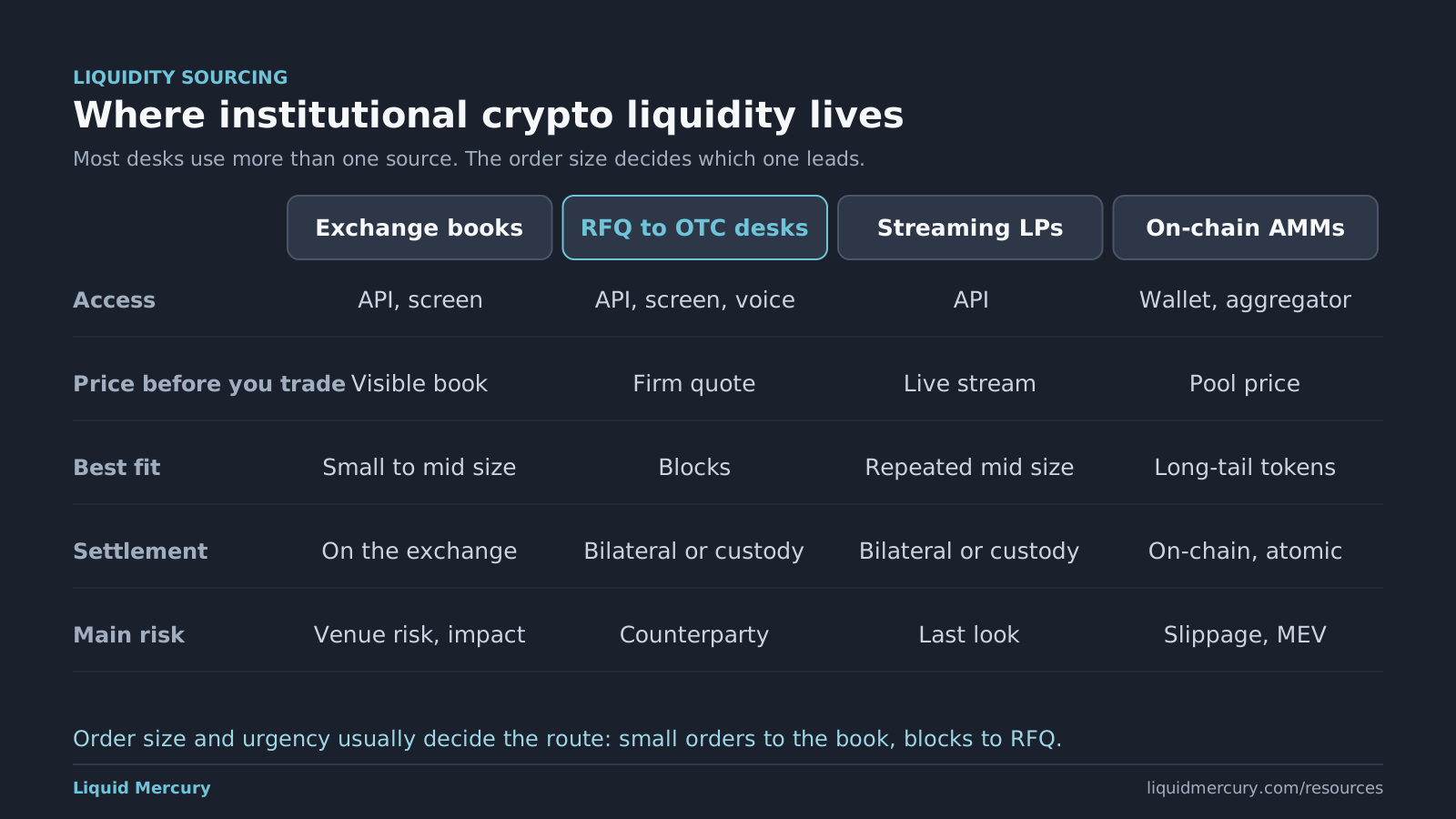
| Source | How you access it | Price before you trade | Best fit | Main risk |
|---|---|---|---|---|
| Exchange order books | API or exchange screen | Visible bids and offers | Small to mid size, liquid pairs | Venue failure, market impact |
| OTC desks by RFQ | API, screen, chat or voice | Firm quote on request | Blocks and illiquid pairs | Counterparty and settlement risk |
| Streaming liquidity providers | API | Live executable prices | Repeated mid-size flow | Last look and counterparty risk |
| On-chain AMMs and DEX aggregators | Wallet or aggregator | Price from the pool curve | Long-tail tokens, on-chain settlement | Slippage, MEV, smart contract risk |
An OTC desk quoting by request for quote gives one firm price for the full size, which removes the guesswork of walking a book. A request for stream gives a price that updates continuously. A lit venue shows its book to everyone, which helps price discovery but tells the market what you are doing. For how OTC desks run, see OTC trading in crypto and crypto block trading.
API, screen and voice: three ways to reach liquidity
- API. Systems talk to venues and dealers directly, through FIX, REST or WebSocket connections. This is how algorithms, smart order routers and automated hedging reach liquidity. See FIX API connectivity for crypto.
- Screen. A trader works orders in an execution or OTC platform that shows aggregated prices and dealer quotes side by side. This keeps a human in control of timing and size.
- Voice and chat. Large or unusual trades are still negotiated with a dealer by phone or chat, then booked. It is flexible, but slow to reconcile and hard to audit unless the platform captures the conversation and the ticket together.
A desk that offers clients all three, or uses all three itself, needs them to land in one record. Otherwise the same exposure sits in three places and nobody sees the total.
How to handle crypto liquidity sourcing, step by step
- Map the sources by asset. For each pair you trade, list the exchanges, dealers, streaming providers and pools that quote it, with typical depth.
- Set up access and credit. Open venue accounts, sign dealer agreements, agree settlement terms and decide how much to keep prefunded on each venue. See pre-funding.
- Aggregate prices. Bring order books and dealer streams into one view so the desk sees the best available price, net of fees.
- Route by size and urgency. Send small orders to books, often through a smart order router. Put blocks out for quotes to a short list of dealers so the order does not leak. Slice large orders that must go to books with algorithms such as TWAP.
- Control risk before the trade. Check limits per venue and per counterparty before an order goes out, and stop routing to a venue that pauses withdrawals.
- Settle and reconcile. Match fills, transfers and custody balances every day. See counterparty risk in digital asset OTC trading.
- Measure the result. Compare fills with the arrival price and with the quotes you declined, then adjust the dealer list and routing rules. See best execution in crypto.
How to reduce slippage on large crypto trades
Slippage is the gap between the price you expected and the price you got. For treasury teams and funds moving size, these habits do the most:
- Ask several dealers for a firm quote on the full size before touching a public book.
- Do not show the same order to every dealer at once. A short, trusted list leaks less information.
- When an order must go to the books, slice it over time and across venues instead of sweeping one exchange.
- Trade the most liquid route. A pair with thin depth can sometimes be reached through a deeper intermediate pair or stablecoin.
- Agree settlement terms before you trade, so a good price is not lost to a failed or delayed transfer.
For corporate holders, see corporate bitcoin treasury liquidity.
What to ask a liquidity or aggregation platform
- Which exchanges, OTC desks and liquidity providers are connected today?
- Can one screen show order books and dealer quotes together, net of fees?
- Are credit checks and limits enforced on OTC fills before they are accepted?
- Does it support RFQ, request for stream and streaming prices, with single-dealer or multi-dealer pricing?
- How are voice and chat trades captured into the same record?
- What reporting does the desk get: fills, venues, slippage and counterparty exposure?
How Liquid Mercury supports liquidity sourcing
Liquid Mercury, the Chicago-based institutional digital asset infrastructure provider, sells two products that cover this workflow. Mercury Pro is an execution and order management system that connects to exchanges, OTC liquidity providers and custodians listed on its product page, with smart order routing and pre-trade risk controls. Mercury OTC turns voice-and-chat OTC into an electronic RFQ workflow with request for quote, request for stream and streaming prices, in single-dealer, multi-dealer or hybrid pricing set-ups.
One documented example is K33, a crypto broker regulated by the Norwegian Financial Supervisory Authority, which used Mercury OTC to automate its RFQ desk across 200 trading pairs and 8 fiat currencies. See the K33 case study.
Frequently Asked Questions
How do institutions access deep crypto liquidity?
Which firms offer crypto liquidity through API, screen and voice?
What systems help institutions find liquidity across order books, AMMs and OTC desks?
Are market makers the same as liquidity providers?
What is a crypto liquidity provider?
How do liquidity aggregators enforce credit checks on OTC fills?
Mercury Pro
Mercury Pro connects your desk to exchanges, OTC liquidity providers and custodians from one execution and order management system.
Request a Mercury Pro demoRelated Reading
Crypto Liquidity Provision
The other side of the trade: how liquidity providers quote, hold inventory and manage risk.
Crypto Execution Management System (EMS)
What an EMS does on a digital asset desk, how it differs from an OMS, and how to compare providers.
Smart Order Routing in Crypto
How a router splits an order across venues and what it weighs beyond price.
Crypto Block Trading
How large crypto trades are priced and executed away from public order books.