
Banks use tokenization to move money and assets on shared ledgers: deposits that transfer around the clock, bonds issued and settled digitally, fund shares that can serve as collateral, and smart contracts in trade finance. Several large banks now run live programs, and central banks are testing how tokenized deposits settle against central bank money.
Do banks use tokenization?
Yes, and not only in pilots. J.P. Morgan says its Kinexys blockchain unit, formerly Onyx, has processed more than $4 trillion in transactions since inception (J.P. Morgan, July 2026). Citi moved Citi Token Services from pilot to a live service in October 2024 (Citi). HSBC extended its Tokenised Deposit Service to the United States in April 2026 (HSBC).
Most bank tokenization today runs on permissioned ledgers for institutional clients, and some programs use public chains. The common goal is the same: move money and assets at any hour, with a shared record and fewer reconciliation breaks. For the general concept, see what RWA tokenization is.
Tokenized deposits vs stablecoins vs wholesale CBDC
| Tokenized deposit | Stablecoin | Wholesale CBDC | |
|---|---|---|---|
| Issued by | A commercial bank | Usually a non-bank issuer | A central bank |
| Holder's claim | On the issuing bank, like a deposit | On the issuer and its reserves | On the central bank |
| Who can hold it | The bank's clients | Often anyone with an eligible wallet | Banks and approved institutions |
| Typical use | Client payments, treasury, settlement | Crypto trading, payments, on-chain settlement | Interbank settlement |
The BIS describes tokenized deposits as claims on the commercial bank that issues them, and wholesale central bank digital currency as playing a role similar to reserves (BIS Annual Economic Report 2023, chapter III). In its 2025 report it argues that tokenized commercial bank money can build on the existing two-tier system, while stablecoins typically fall short on the test of singleness: one dollar always worth one dollar (BIS Annual Economic Report 2025, chapter III). See also the stablecoin glossary entry.
J.P. Morgan describes JPM Coin as a deposit token. After a pilot in June 2025, it launched a deposit token on Base, a public Ethereum layer 2 network, as a live offering for institutional clients in November 2025 (J.P. Morgan).
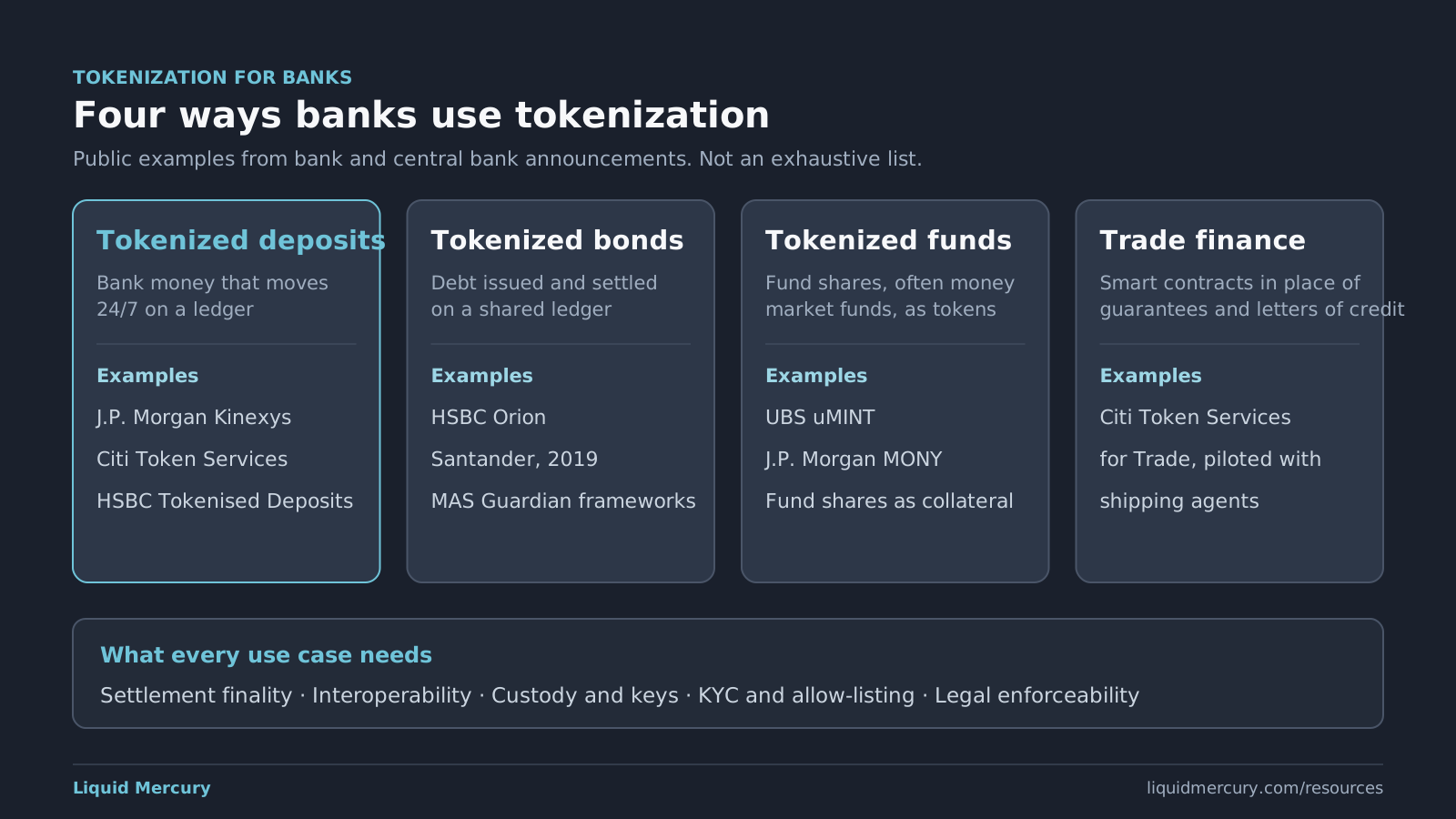
Four ways banks use tokenization
1. Tokenized deposits and payments
Clients move money between accounts, entities and countries outside banking hours. Citi says Citi Token Services is live in the US, UK, Singapore and Hong Kong (Citi, November 2025). HSBC says eligible clients can transfer funds 24/7, domestically and across borders. In August 2026 Standard Chartered and HSBC announced a live cross-border tokenized deposit transaction on Swift's blockchain-based ledger (Standard Chartered).
2. Digital bonds
Banks issue and settle bonds on distributed ledgers. Santander issued a $20 million bond end to end on the public Ethereum blockchain in 2019 (Santander). HSBC's Orion platform supported a HKD 10 billion digital bond in Hong Kong in November 2025 (HSBC), and in July 2026 Orion became the first applicant to go live in the UK Digital Securities Sandbox (HSBC).
3. Tokenized funds and collateral
Banks and their asset managers issue fund shares as tokens, most often money market funds. UBS launched uMINT, a tokenized USD money market fund on Ethereum, through UBS Tokenize in November 2024 (UBS). Tokenized fund shares are also being studied as collateral. In October 2026 ISDA published a paper on the questions raised when posting tokenized money market fund shares as collateral under its credit support annex (ISDA). See tokenized money market funds.
4. Trade finance
Smart contracts backed by tokenized cash can replace parts of the paper process for guarantees and letters of credit. Citi piloted Citi Token Services for Trade with shipping agents in 2024 (Citi).
Central bank and public-sector programs
- MAS Project Guardian (Singapore). A sandbox linking financial institutions, industry bodies and regulators to test asset tokenization. In November 2024 MAS released the Guardian Fixed Income Framework and the Guardian Funds Framework as industry guides (MAS).
- BIS Project Agora. Seven central banks and private financial firms testing how tokenized commercial bank deposits and tokenized central bank reserves can work on one programmable platform for cross-border payments (BIS).
- ECB Pontes (euro area). A service to settle wholesale tokenized asset transactions in central bank money, launched in September 2026 (ECB).
- UK Digital Securities Sandbox. A regime run by the Bank of England and the FCA for firms issuing, trading and settling digital securities, opened in September 2024 (FCA).
US regulatory posture for banks
US bank regulators changed course in 2025. In March 2025 the OCC issued Interpretive Letter 1183, which confirmed that crypto-asset custody, certain stablecoin activities and participation in node verification networks are permissible for national banks, and removed the requirement to obtain supervisory non-objection before starting them (OCC). In April 2025 the Federal Reserve withdrew guidance that had asked state member banks to notify it before starting crypto activities (Federal Reserve). In January 2025 SEC Staff Accounting Bulletin 122 rescinded SAB 121 (SEC). See SAB 121.
Rules continue to change. Treat this as background, not legal advice, and confirm current requirements with counsel and your supervisor.
What a bank needs from a tokenization platform
The Financial Stability Board's 2024 report names the barriers to scale: weak interoperability between ledgers and with existing infrastructure, limited settlement assets on-chain, legal uncertainty about token holders' claims, and key management (FSB, October 2024). A bank's platform has to answer each of them.
- Settlement finality. A clear legal point at which a transfer is final, and a cash leg that settles with the asset. See delivery versus payment and atomic settlement.
- Interoperability. Connections to core banking, payments, custody and the bank's books and records, and to more than one ledger.
- Custody and key management. Institutional custody with clear segregation of client assets.
- KYC and allow-listing. Only verified clients can hold or receive the token, enforced in the token's own rules.
- Legal enforceability. Documentation that ties the token to the underlying asset or claim in each jurisdiction.
- A secondary market. If clients will trade the asset, a venue with price discovery and eligible counterparties.
On build versus partner, see RWA tokenization platform: build, license or white-label. For settlement of digital asset trades in stablecoins, see institutional stablecoin settlement.
Where Mercury RWA fits
Liquid Mercury, the Chicago-based institutional digital asset infrastructure provider, built Mercury RWA to run secondary markets for tokenized assets. For a bank, that means a white-label marketplace under the bank's brand where eligible clients can trade tokenized assets after issuance, with automated KYC and AML checks, smart contract-based transfer restrictions, BitGo custody integration and delivery-versus-payment settlement, as described on the product page.
Frequently Asked Questions
Which banks offer tokenized deposits?
What is a deposit token?
What is the difference between a tokenized deposit and a stablecoin?
Can tokenized assets settle in minutes instead of days?
What is Project Guardian?
Can US national banks custody crypto assets?
Mercury RWA
Give your clients a branded secondary market for tokenized assets, with compliance, custody and delivery-versus-payment settlement built in.
Request a Mercury RWA demoRelated Reading
RWA Tokenization Platform: Build, License or White-Label?
What a tokenization platform must include and how to choose between building, licensing and white-label.
Tokenized Money Market Funds
How tokenized money market funds work, who issues them and how they are used as collateral.
Tokenized Treasuries
How tokenized US Treasury products work and how institutions trade them.
Institutional Stablecoin Settlement
How institutions settle trades in stablecoins, and the risks to check first.