
A tokenized money market fund is an ordinary money market fund whose shares are also recorded and transferred as tokens on a blockchain. The fund still holds cash, Treasuries and repo. What changes is the record and the rails: some funds permit transfers between approved wallets outside market hours or collateral use, subject to the offering documents and platform rules.
What is a tokenized money market fund?
A money market fund invests in short-term, high-quality debt such as Treasury bills and repurchase agreements. Its valuation and income rules depend on the fund. A tokenized fund uses blockchain records to represent shares or mirror official ownership records, depending on its legal structure. Examples below include registered money market funds and private institutional cash-management funds. Their investor eligibility, valuation, income and transfer rules differ.
Tokenization changes how ownership is recorded and transferred, not what the fund owns. SEC staff said in a January 2026 statement that whether a security's ownership records are kept on-chain or off-chain does not change how the federal securities laws apply (SEC). For the related product type, see tokenized Treasuries, and for the wider category, tokenized securities.
How a tokenized money market fund works
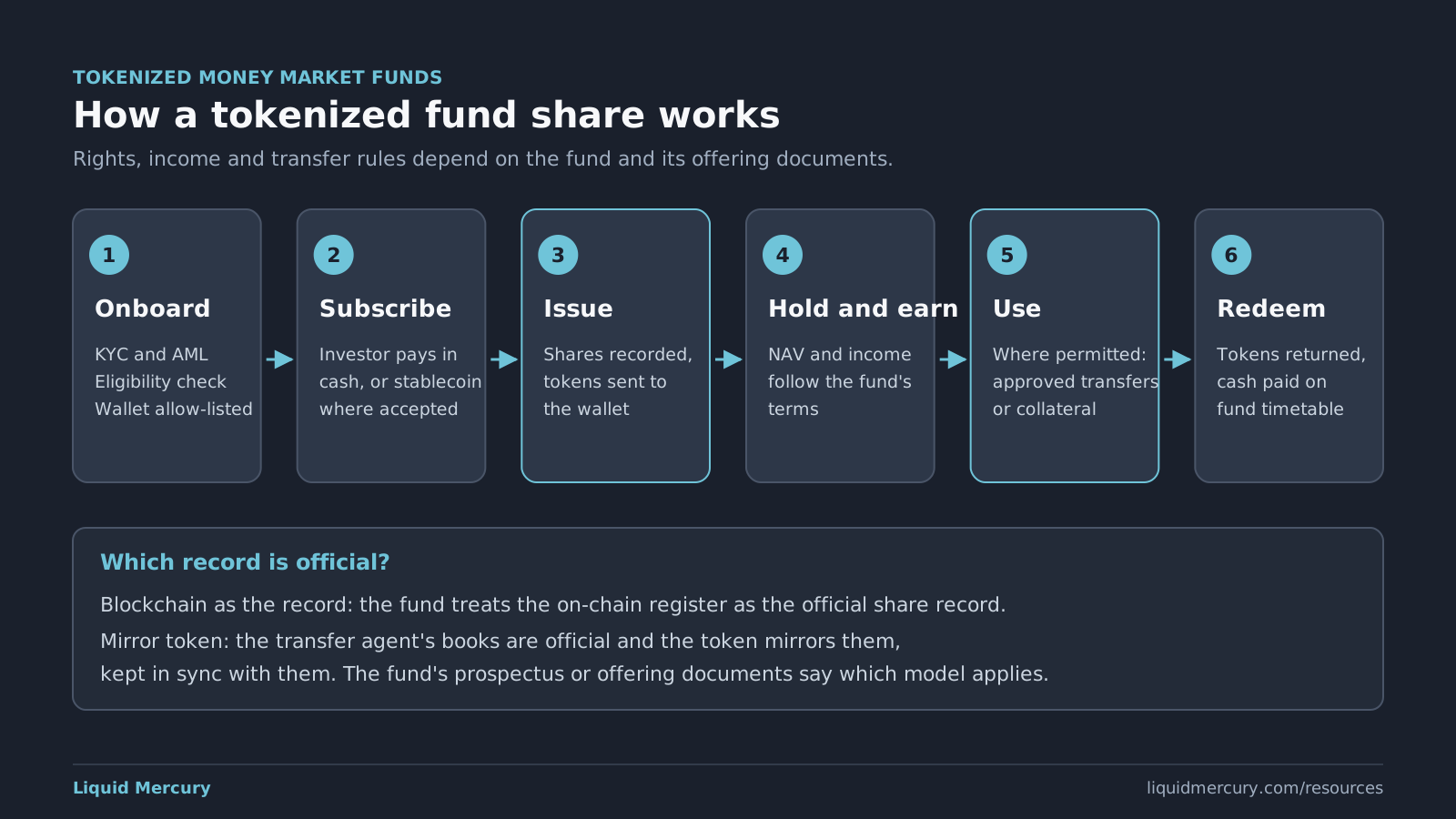
- Onboard. The investor passes KYC, AML and eligibility checks, and its wallet address is added to the fund's allow-list.
- Subscribe. The investor pays in cash, or in a stablecoin where the fund accepts one.
- Issue. The transfer agent records the new shares and tokens are sent to the investor's wallet.
- Hold and earn. The fund strikes its net asset value and accrues income daily. Some funds pay income as new tokens. BlackRock's BUIDL, for example, accrues dividends daily and pays them as new tokens each month (BlackRock, via Nasdaq).
- Use. Where the fund permits it, investors may transfer tokens to other eligible, approved wallets or post them as collateral where accepted. Timing and approvals depend on the fund and platform.
- Redeem. The investor returns tokens and receives cash on the fund's timetable, which for many funds still follows business days.
Which record is official?
Two models are in use. In one, the blockchain is the system of record. Franklin Templeton's prospectus for its OnChain US Government Money Fund describes a transfer agent that keeps the official ownership record through a blockchain-integrated system (SEC filing). In the other, the transfer agent keeps the official books and the token mirrors them. BNY and Goldman Sachs launched a mirror-token model in July 2025, with BNY keeping the official books and records (Goldman Sachs). The offering documents say which model a fund uses.
Tokenized money market funds and their issuers
| Fund | Manager | Launched | Chain at launch | Investor access |
|---|---|---|---|---|
| Franklin OnChain U.S. Government Money Fund (FOBXX, BENJI token) | Franklin Templeton | 2021 | Stellar | US-registered fund |
| WisdomTree Government Money Market Digital Fund (WTGXX) | WisdomTree | 2023 | Stellar | Through WisdomTree's digital platform |
| BlackRock USD Institutional Digital Liquidity Fund (BUIDL) | BlackRock, with Securitize | March 2024 | Ethereum | Qualified investors, $5 million minimum at launch |
| UBS USD Money Market Investment Fund Token (uMINT) | UBS Asset Management | November 2024 | Ethereum | Through authorized distribution partners |
| Fidelity Treasury Digital Fund, OnChain class (FYOXX) | Fidelity | 2025 | Ethereum | $1 million minimum initial investment |
| J.P. Morgan tokenized money market fund (MONY) | J.P. Morgan Asset Management | December 2025 | Ethereum | Private placement for qualified investors |
Sources: the Stellar Development Foundation on Franklin Templeton, WisdomTree's 2023 prospectus, the BUIDL launch release, UBS, Fidelity's SEC filing and J.P. Morgan. Many of these funds have since added other chains.
The market has grown quickly. As of October 20, 2026, rwa.xyz tracked about $14.71 billion in distributed tokenized US Treasury funds and similar products across public chains (rwa.xyz). Figures change daily, so check the source for the current number.
How institutions use tokenized money market funds
- Treasury cash. Firms that hold stablecoins or trade digital assets can keep idle cash in a yield-bearing fund token without moving it back to a bank account.
- Collateral. Trading venues have started to accept fund tokens as margin. Binance said in November 2025 that it would accept BUIDL as off-exchange collateral (Securitize and Binance).
- Stablecoin and DeFi reserves. New York Fed researchers describe tokenized funds used for stablecoin liquidity, as reserve assets for on-chain products and as derivatives margin (Liberty Street Economics).
- Transfers outside market hours. Some funds permit approved holders to move shares outside market hours. Availability depends on the fund's transfer rules, transfer-agent controls and platform support; tokenization alone does not make shares freely transferable.
Collateral use raises its own questions about valuation, haircuts and legal transfer. ISDA published a paper on tokenized money market fund shares as collateral under its credit support annex in October 2026 (ISDA). For banks, see tokenization for banks.
Risks and limits
- Liquidity mismatch. Tokens can move at any hour, but the fund's assets and redemptions run on market hours. The BIS says tokenized money market funds carry risks that mirror, and could amplify, those of conventional funds (BIS Bulletin 115).
- Allow-lists have limits. Allow-listing controls who holds the token directly, but tokens used inside other products can create exposure further away.
- Operational risk. Fund documents warn that blockchain processing can be delayed, and smart contracts and keys add new failure points.
- Eligibility. Many products are open only to qualified or accredited investors, or exclude US persons.
- Secondary trading is thin. Most holders subscribe and redeem with the fund. Trading between investors is limited to approved wallets and few venues.
Where Mercury RWA fits
Liquid Mercury, the Chicago-based institutional digital asset infrastructure provider, built Mercury RWA to run secondary markets for tokenized assets, including funds. Its product page describes primary and secondary trading, automated investor verification, programmable transfer restrictions and delivery-versus-payment settlement with BitGo custody. Mercury RWA provides infrastructure for issuers to offer secondary trading to eligible investors, subject to each instrument’s transfer restrictions. For the platform decision, see RWA tokenization platform: build, license or white-label.
Frequently Asked Questions
How does a tokenized money market fund work?
Are tokenized money market funds safe?
What is BUIDL?
What is the difference between a tokenized money market fund and a stablecoin?
Can tokenized money market funds be used as collateral?
Mercury RWA
Run a compliant secondary market for tokenized funds and other assets, with investor verification and delivery-versus-payment settlement.
Request a Mercury RWA demoRelated Reading
Tokenized Treasuries
How tokenized US Treasury products work and how institutions trade them.
Stellar for RWA Tokenization
The Stellar features that fund issuers such as Franklin Templeton use for regulated assets.
Tokenization for Banks
Tokenized deposits, bonds, funds and collateral, and what banks need from a platform.
RWA Tokenization Platform: Build, License or White-Label?
What a tokenization platform must include and how to choose a route to market.