
An RWA tokenization platform is the software and operating stack that turns a real-world asset into a token, checks who may hold it, records transfers and lets investors trade it. Issuers can build one, license one or launch a branded white-label platform. The right choice depends on time, budget, control and who carries the regulated roles.
What an RWA tokenization platform does
Tokenization records ownership of an asset, or a claim on it, as a token on a shared ledger. The asset might be a fund share, a bond, private credit, real estate or a commodity. The platform is everything around that token that makes it usable by regulated investors. For the basics, start with what RWA tokenization is and the RWA glossary entry.
| Layer | What it does | What to ask |
|---|---|---|
| Legal wrapper | Links the token to the asset, often through a fund or special purpose vehicle | Who holds the asset, and what right does the token give? |
| Token and rules | Creates the token and enforces who can hold and transfer it | Can it freeze, recover or force a transfer under a court order? |
| Investor onboarding | KYC, AML and eligibility checks, then allow-listing of wallets | Which jurisdictions and investor types are supported? |
| Registry | Keeps the record of ownership, on-chain or with a transfer agent | Which record is official, and how are the two reconciled? |
| Custody | Holds tokens and keys for investors and the issuer | Which custodians are integrated? |
| Primary issuance | Subscriptions, minting, distributions and redemptions | How is the cash leg handled? |
| Secondary market | Price discovery and trading between eligible investors | Is there a venue, and who operates it? |
| Settlement and reporting | Delivery versus payment, reconciliation, investor and regulatory reports | Is settlement atomic, and what reports come out? |
Each step from asset to token is covered in the RWA tokenization process. This page is about the platform decision.
Tokenization alone is not a market
Many platforms stop at issuance. The token exists, investors hold it, and nothing trades. Liquidity needs a place where eligible buyers and sellers meet, prices they can trust, and settlement that moves the token and the cash together. In the US, a venue that matches buyers and sellers of securities usually has to register as an exchange or operate as an alternative trading system.
If secondary trading matters to your investors, make it part of the platform decision from the start. See the tokenized securities secondary market and how a tokenized securities marketplace works.
Build, license or white-label
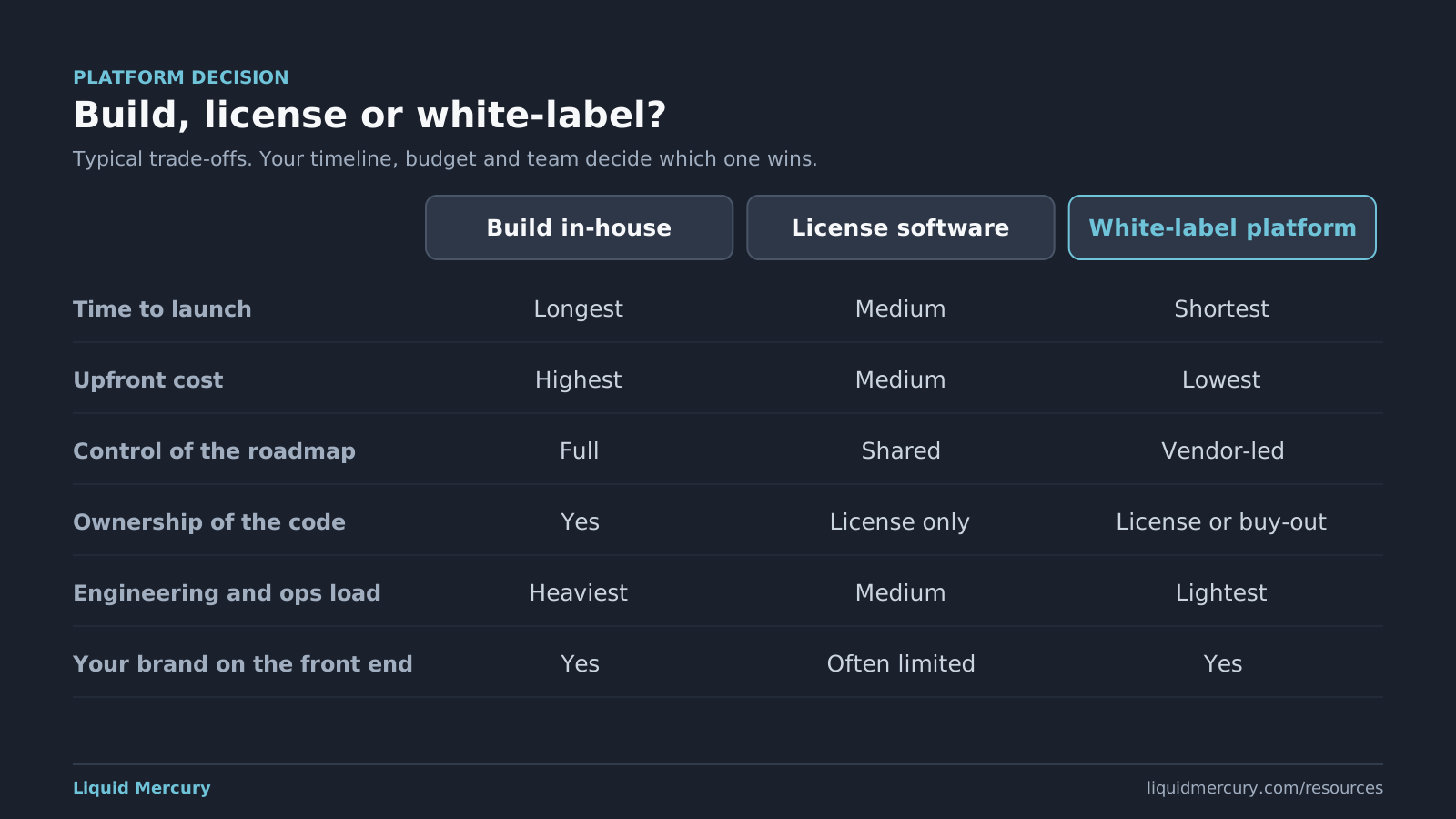
- Build in-house. You hire or contract engineers to write the token contracts, onboarding, registry, custody integrations and trading. You own the code and the roadmap. You also own every bug, audit, upgrade and on-call shift. This suits a large institution with a long horizon and an unusual asset or workflow.
- License software. You license a vendor's tokenization modules and assemble them inside your own operation. Faster than a build, and you keep the operating control, but integration work and front-end design still sit with you.
- White-label platform. You launch a complete platform under your brand on a vendor's stack, configured to your assets and rules. It is usually the fastest route to market. The trade-off is that the vendor leads the roadmap, so check how feature requests, upgrades and exit rights work.
Some vendors offer a path between these: launch on a white-label platform, then buy the code later. Ask about it early, because it changes how you value the vendor relationship.
What drives the cost of building a tokenization platform
Published cost figures for building an RWA tokenization platform vary widely and usually come from development agencies selling the build. The more useful question is what drives the cost, so you can price your own case:
- Legal structure and licensing. Fund or SPV set-up, offering documents and, in the US, whether you need a broker-dealer, transfer agent or ATS, or a partner who has one.
- Smart contract security. Writing, testing and independently auditing the token and transfer-rule contracts, then re-auditing after each upgrade.
- Integrations. KYC and AML providers, custodians, payment rails, stablecoin or tokenized deposit settlement, and your existing books and records.
- Trading. Matching, market data, surveillance and settlement if you want a secondary market rather than issuance alone.
- Running it. Security, monitoring, incident response, support and upgrades, every day, for the life of the asset.
Most of these costs recur. Compare the total over three to five years, not the first invoice.
Compliance features that matter
- Transfer restrictions in the token. Only verified, eligible wallets can receive the token, and the rules can change when regulation or the offering changes.
- Eligibility by investor type and jurisdiction. Accredited, qualified purchaser, professional or retail, and blocks on restricted countries.
- Freeze, recovery and forced transfer. Needed for lost keys, court orders and sanctions. Some chains build these controls into the protocol. See Stellar for RWA tokenization.
- One official record. Clear rules on whether the chain or the transfer agent holds the official register, and daily reconciliation between them.
- Audit trail and reporting. Every issuance, transfer, freeze and redemption logged and reportable to regulators and investors.
- Delivery versus payment. The token moves only if the cash moves. See delivery versus payment.
How to evaluate a white-label tokenization platform
- Which asset types has the platform already carried into production, and on which chains?
- Does it cover issuance only, or issuance plus secondary trading and settlement?
- Which regulated roles does the vendor or its partners hold, and which must you hold?
- How are KYC, AML and investor eligibility handled, and can you bring your own providers?
- Which custodians are integrated, and how does delivery versus payment work?
- How much of the front end carries your brand, and how much can you configure without code?
- What does it take to add an asset class, a chain or a new jurisdiction?
- What are the exit terms: data export, code escrow or an option to buy the code?
For a list of firms working in the market, see RWA tokenization companies. For banks, see tokenization for banks. For one of the most common tokenized assets today, see tokenized money market funds.
Where Mercury RWA fits
Liquid Mercury, the Chicago-based institutional digital asset infrastructure provider, built Mercury RWA for the part of the platform that most issuance tools leave out: the secondary market. Its product page describes a white-label marketplace that carries the issuer's brand, support for primary issuance and secondary trading, automated KYC and AML checks, smart contract-based transfer restrictions, and a settlement stack of Mercury Ledger, reconciliation, BitGo custody and delivery-versus-payment settlement.
Mercury RWA also lists an option to acquire the entire technology stack, for issuers who want to start on a white-label platform and own the code later. Liquid Mercury states an implementation window of four to twelve weeks for its platform.
Frequently Asked Questions
How much does it cost to build an RWA tokenization platform?
What is tokenization as a service?
What is a white-label tokenization platform?
Can a tokenization platform settle trades instantly?
What does a fund need to issue tokenized bonds with secondary trading?
What are the downsides of asset tokenization?
Mercury RWA
Launch a branded secondary market for your tokenized assets with Mercury RWA, with compliance, custody and delivery-versus-payment settlement built in.
Request a Mercury RWA demoRelated Reading
The RWA Tokenization Process
Seven steps from asset to token, from the legal wrapper to secondary trading.
Tokenization for Banks
How banks use tokenized deposits, funds, bonds and collateral, and what they need from a platform.
Tokenized Money Market Funds
How tokenized money market funds work, who issues them and how institutions use them.
Stellar for RWA Tokenization
The Stellar features issuers use for regulated assets: issuer controls, regulated asset approvals and fast settlement.