
Stellar is a public blockchain built for issuing and moving assets. For real-world asset tokenization, its main draw is that issuer controls such as approval, freezing and clawback are part of the protocol rather than custom smart contract code. Franklin Templeton, WisdomTree and other issuers use it for tokenized funds.
Why RWA issuers look at Stellar
Most tokenization projects need three things from a chain: control over who holds the asset, a way to connect to bank money, and fast, cheap, final settlement. Stellar was designed around asset issuance and payments, so much of that sits in the protocol and in shared standards called Stellar Ecosystem Proposals (SEPs).
Franklin Templeton launched its Franklin OnChain U.S. Government Money Fund on Stellar in 2021, and the Stellar Development Foundation describes it as the first US-registered tokenized money market fund (Stellar Development Foundation). WisdomTree's government money market digital fund started on Stellar in 2023. See tokenized money market funds for how these funds work.
Stellar RWA tokenization platform features
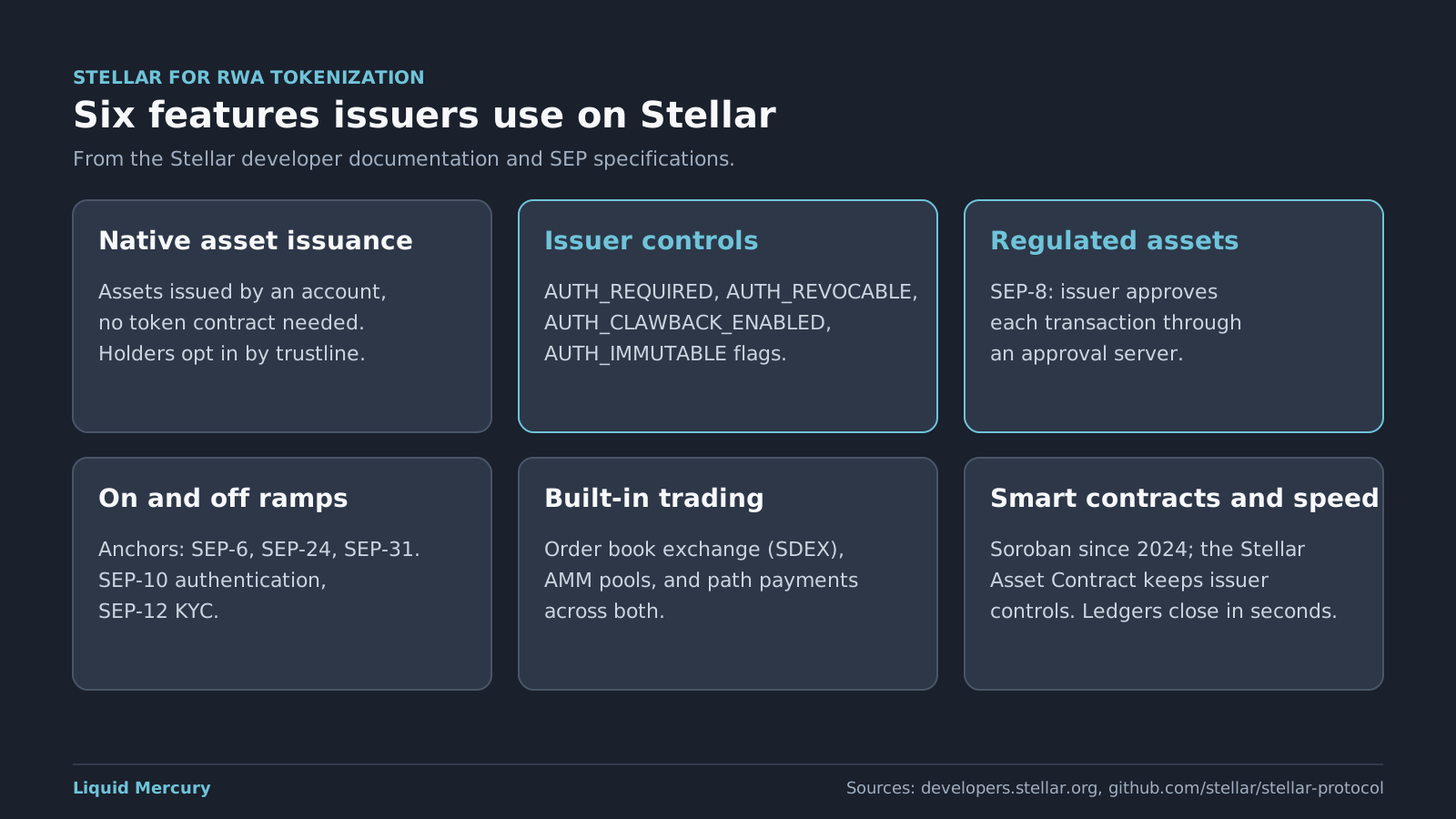
1. Native asset issuance and trustlines
Any Stellar account can issue an asset, and the issuing account keeps control of it (Stellar docs). A holder must first create a trustline, an explicit opt-in to hold that asset, which reserves 0.5 XLM in the holder's account (Stellar docs). The Stellar docs now describe three token models: native Stellar assets, contract tokens that follow the SEP-41 interface, and permissioned T-REX tokens under SEP-57, which is still a draft standard.
2. Issuer control flags
| Flag | What it does | Why an RWA issuer uses it |
|---|---|---|
| AUTH_REQUIRED | The issuer must approve an account before it can hold the asset | Only verified, eligible investors can hold the token |
| AUTH_REVOCABLE | The issuer can revoke a trustline's authorization, freezing the asset | Freeze holdings for sanctions or a court order |
| AUTH_CLAWBACK_ENABLED | The issuer can claw back the asset from trustlines created after the flag is set; requires AUTH_REVOCABLE | Recover tokens after lost keys or a legal order |
| AUTH_IMMUTABLE | Locks the other flags and stops the issuing account being merged | Commit publicly that the rules will not change |
Source: Stellar docs on controlling asset access. Clawback arrived with protocol version 17 under CAP-35. The Stellar Development Foundation's Franklin Templeton case study says the manager needed to authorize every share transfer and to freeze accounts and claw back shares (Stellar).
3. Regulated assets with SEP-8
SEP-8 lets an issuer require its approval for each transaction in an asset, not just for each holder. Wallets send the transaction to the issuer's approval server, which checks it against the issuer's rules and signs it or rejects it (SEP-8). WisdomTree used this standard for its digital funds, according to the Stellar Development Foundation.
4. Anchors and on and off ramps
- SEP-6. A programmatic way for wallets and anchors to handle deposits and withdrawals.
- SEP-24. Hosted, interactive deposit and withdrawal flows.
- SEP-31. Payments between two financial accounts that sit outside the Stellar network, used for cross-border flows.
- SEP-10. Authentication of a user who controls a Stellar account.
- SEP-12. A standard way to send KYC information to anchors and other services.
The full specifications are in the Stellar protocol repository. Stablecoins on Stellar include USDC, live since February 2021 (Stellar), and PayPal USD, live since September 2025 (Stellar), which gives tokenized assets an on-chain cash leg.
5. Built-in trading
Stellar has an order book exchange in the protocol, often called the SDEX, and constant-product liquidity pools with a 30 basis point fee, added in protocol 18 under CAP-38 (Stellar docs). Path payments convert one asset to another across both in a single transaction. Issuer controls still apply, so a regulated asset only trades between authorized accounts.
6. Smart contracts, settlement speed and fees
Soroban smart contracts went live on mainnet when validators voted in Protocol 20 on February 20, 2024 (Stellar). The Stellar Asset Contract lets contracts use native Stellar assets while keeping issuer controls and trustline rules (Stellar docs). Stellar reaches consensus through the Stellar Consensus Protocol, and its documentation says validators update the ledger every 5 to 7 seconds (Stellar docs). The minimum fee is 100 stroops per operation, where one stroop is one ten-millionth of an XLM (Stellar docs).
Real-world assets on Stellar
- Franklin Templeton. Franklin OnChain U.S. Government Money Fund, launched on Stellar in 2021.
- WisdomTree. Digital funds offered through WisdomTree Prime. WisdomTree said in September 2025 that its private credit fund would be tokenized on Ethereum and Stellar at launch (WisdomTree).
- Ondo Finance. Launched its US Dollar Yield token on Stellar in September 2025 (Stellar).
- DTCC. Said in 2026 that it expects DTC-tokenized assets to be available on Stellar in the first half of 2027. That is a plan, not a live service (PR Newswire).
As of October 20, 2026, rwa.xyz showed about $3.55 billion in distributed real-world asset value across 83 assets on Stellar (rwa.xyz). The Stellar Development Foundation gives its own, higher figure, so cite each source with its date rather than mixing them.
How to evaluate Stellar for your asset
- Control model. Do you need approval per holder (AUTH_REQUIRED) or per transaction (SEP-8)? Do you need clawback, and will you set it before the first trustline?
- Where your investors are. Which custodians, wallets and venues your investors already use, and whether they support Stellar assets.
- Cash leg. Which stablecoins or anchors will settle subscriptions, redemptions and trades.
- Other chains. Many issuers run the same fund on several chains. Decide how records stay in sync.
- Secondary market. Where eligible holders will trade, and how trades settle against cash. See RWA tokenization platform: build, license or white-label.
Where Liquid Mercury fits
Liquid Mercury, the Chicago-based institutional digital asset infrastructure provider, builds secondary market infrastructure for tokenized assets through Mercury RWA, with investor verification, transfer restrictions and delivery-versus-payment settlement. Ask Liquid Mercury which chains it supports for your asset before choosing a chain.
Frequently Asked Questions
Is Stellar good for real-world asset tokenization?
What is SEP-8 on Stellar?
Can an issuer freeze or claw back tokens on Stellar?
How fast are Stellar transactions?
Does Stellar support smart contracts?
Mercury RWA
Turn tokenized assets into active institutional markets with Mercury RWA, with investor verification, transfer restrictions and delivery-versus-payment settlement.
Request a Mercury RWA demoRelated Reading
Tokenized Money Market Funds
How tokenized money market funds work, with Franklin Templeton, BlackRock and others.
RWA Tokenization Platform: Build, License or White-Label?
What a tokenization platform must include and how to choose a route to market.
Tokenized Securities
What tokenized securities are, the main types and how they trade.
Tokenization for Banks
How banks use tokenized deposits, bonds, funds and collateral.